
5 Kidney Support Things I Trusted For My Cats That I No Longer Do (And Why)

I’m in a lot of feline CKD Facebook groups. I joined them years ago when Joey was first diagnosed and I felt completely alone, terrified, desperate, and certain I was about to lose him. Those groups became a lifeline. They still are. But I’ve been in them long enough now to watch something repeat so consistently it stopped feeling like coincidence.
A cat guardian posts:
“Has anyone had luck with XYZ supplement? My cat just got diagnosed and I’m terrified. My vet said to just feed the prescription kidney diet and wait, but I couldn’t sit there. I had to do something.”
A handful of people respond with confidence. A brand name. A link. “This worked great for my cat. Try it.” So she buys it.
A few weeks later, she’s back. With a completely different post.
“WARNING. Do NOT buy this. My cat got really sick. I looked it up after and found pages of scam reports and sick cats. I should have researched before I spent $60.”
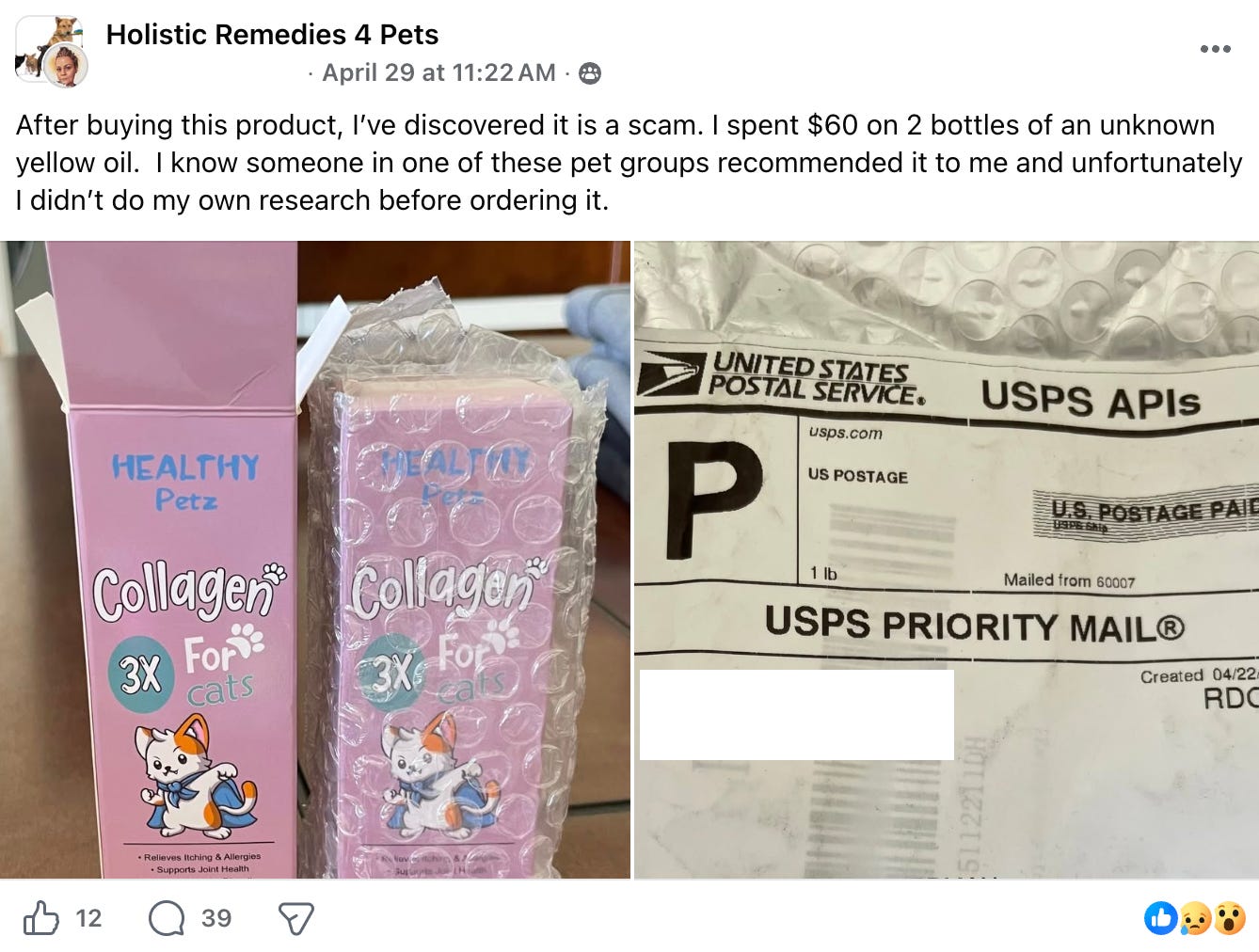
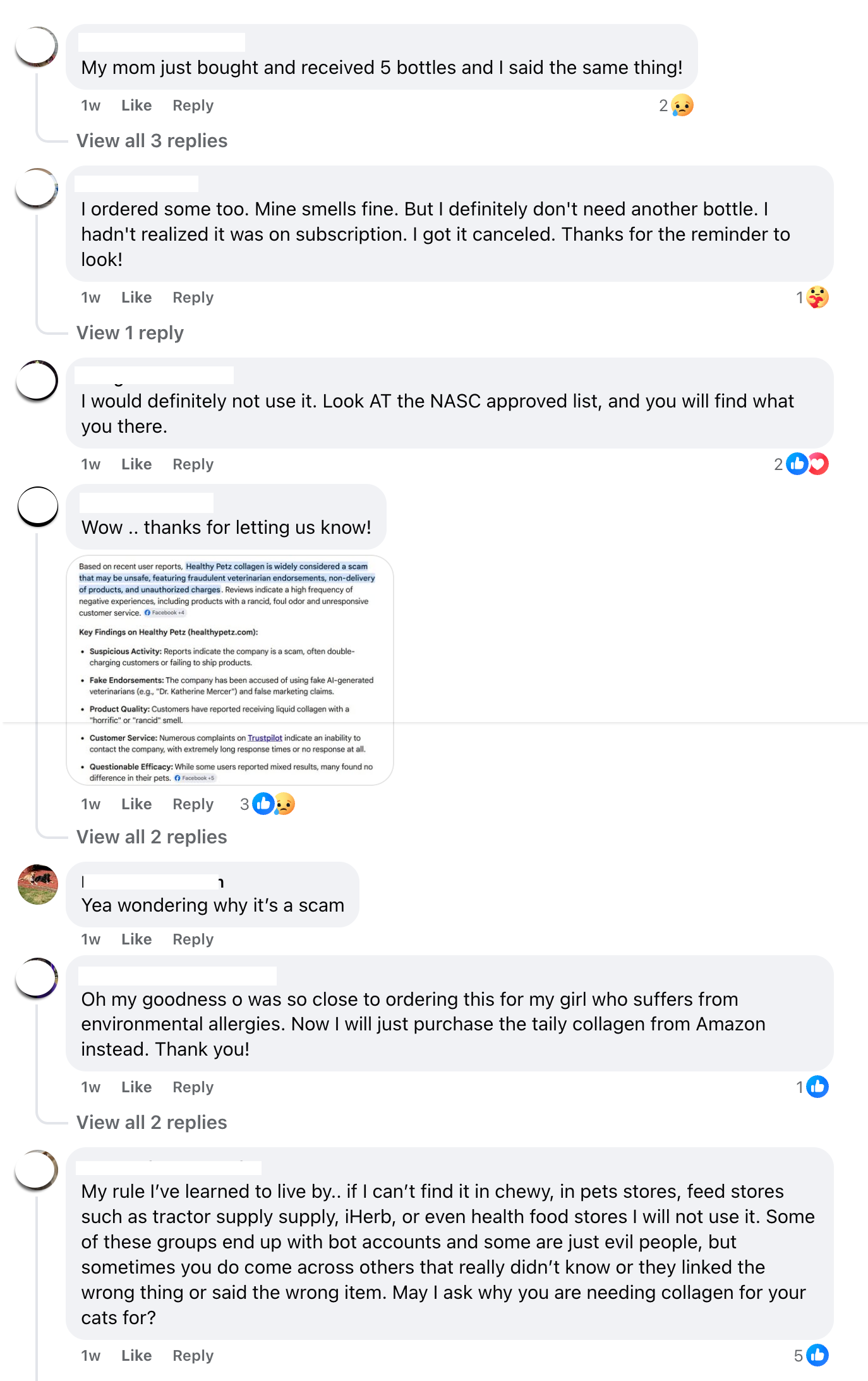
She wasn’t stupid. She wasn’t careless. She was scared and doing everything she could think of to save her cat.
I’ve watched this exact sequence play out at least a dozen times in the past few month alone. A guardian in crisis. A well-meaning recommendation. A product that looks promising. A few weeks of hope. Then a warning. Then guilt. And somewhere in the middle, a cat who got sicker. And a guardian wrecked with guilt.
The pattern isn’t random. I’ve seen it far too many times. It’s a cycle and broken system working precisely how it’s meant to.
Here’s what I want you to understand before I name the specific products or things to steer clear of. This isn’t to shame the people who recommended the products. Their intentions were good. Not all supplements, vets, and pet businesses are bad. And it’s definitely not to shame the cat guardian who’s doing her best to try to find ways to support her sick cat.
This is a call-out of a system that was designed to keep us dependent, not educated.
We’re not taught how to evaluate supplement quality. We’re not taught what questions to ask, what to push back on, or that natural alternatives can be part of an allopathic plan. None of it. Then we’re slapped in the face with a bleak, terrifying CKD diagnosis and met by a vet who says “wait and see“ and hands you a bag of expensive prescription renal food, a bill that makes you do a double-take, and a follow-up appointment six months out. (Ask me how I know. 👀)
No framework for what’s safe. No guidance on what to ask before you spend money on something that claims to help. So you go home, get online, find people in your same situation, and ask what worked for them. Because who else do you ask?
A scared guardian with a sick cat, a credit card, and a supplement that says “kidney support” on the label is an easy transaction for shady businesses. The supplement industry knows this. So does the pet food industry. Your vet wasn’t lying or trying to deceive you when they handed you the bag of prescription food. They graduated believing it was the best choice because that’s what vet school taught them, and vet education has been significantly funded by pet food companies for decades. They gave you what they knew and trusted. It was built this way. A system with incentive structures that have nothing to do with your cat’s long-term health, and everything to do with what’s cheap to produce and profitable to teach.
You were set up to trust blindly. That’s not a failure of your judgment. That’s how the system functions. I know because I’ve been there and made a lot of mistakes along the way. Joey’s CKD diagnosis was the beginning of a very expensive, very humbling lifelong education. Here’s what I learned. Hopefully you’ll learn from my mistakes.
・・・・・ ─ ⚞^. .^⚟ ─ ・・・・・
Hi, I’m Ashley 👋
I’m a holistic cat health educator and someone who learned the hard way that “vet recommended” doesn’t always mean “best for your cat.”
I write for cat guardians who are tired of being dismissed, overwhelmed by conflicting advice, and starting to trust their gut over the label. I cover food, environment, nervous system regulation, herbs, communication, intuition, and the energetic side of the human-cat bond.
New here? Start with these:
Who Really Owns the Cat Food Aisle (And Why That Should Scare You)
If I Were Starting My Holistic Cat Journey Today, I’d Do These 11 Things First
・・・・・ ─ ⚞^. .^⚟ ─ ・・・・・
Prescription renal kibble.
Ugh, this one STILL grinds my gears. My vet told me to feed it and so I did, like the good little girl I was. And Joey’s health paid the price. His labs continued to get worse. I didn’t question it for months because my vet said so, and I assumed that if a vet recommended something, it would help him get healthier or at least FEEL BETTER.
Here’s what I know now: high-quality bioavailable protein combined with real hydration works better for CKD cats than low-quality, low-protein, phosphorus-restricted dry food. The prescription diet manages one marker while ignoring others…hydration, protein quality, carb load, systemic inflammation. And kibble, no matter the formulation, is chronically dehydrating for cats whose kidneys are already struggling. My vet wasn’t lying. She wasn’t trying to hurt Joey. She truly loved him, I know she did. But she was blindly following what the system taught her to.
The panic-buy supplement.
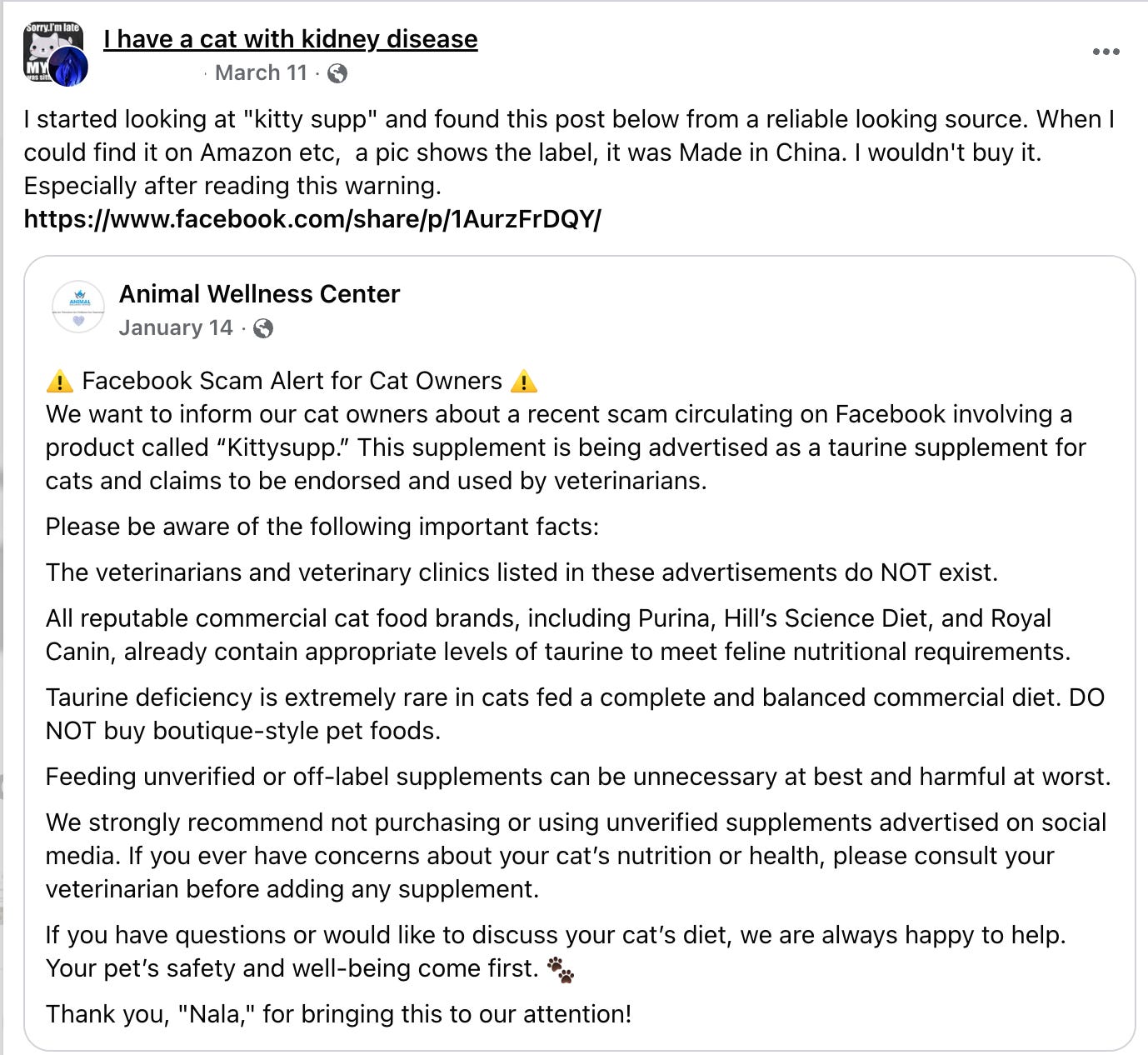
This one, I see ALL the time. A guardian gets the diagnosis, gets dismissed by her vet, goes online and finds a supplement with “kidney support” on the label and decent reviews, and buys it. She doesn’t ask where it was manufactured and where the ingredients were sourced. She doesn’t ask who tested it. She doesn’t ask if the testing was independent or in-house. She doesn’t look for recalls. She just buys it because she’s scared and it says it will help. Weeks later, her cat is worse. And she has no way to know if the supplement was a factor because she never verified a single thing about its quality before she gave it to him. The supplement isn’t inherently evil. The problem is that she had no framework for evaluation. The system made her afraid, then made it easy to buy a solution without teaching her how to verify it first.
Generic raw food that wasn't formulated for a CKD cat.
I knew raw was species-appropriate and a better option for my cats. I knew the protein would be more bioavailable. I switched Joey to a standard raw diet thinking I was doing better than the prescription kibble.
What I didn’t know: a CKD cat has specific nutritional needs that a generic raw diet (even a good one) doesn't account for. Phosphorus restriction. Controlled potassium. The right protein quality and quantity for his specific kidney staging. Moisture levels. The balance of minerals that support kidney function without adding load. A healthy cat can thrive on a well-formulated generic raw diet. A CKD cat needs a diet built around his actual bloodwork, his specific stage, his individual markers, not a one-size-fits-all approach, even a holistic one. For a CKD cat, generic raw diets without mineral adjustment can accelerate decline.
Intention doesn't equal knowledge. Holistic needs to be informed. I was trying to help and I made it worse. Now Joey's diet is formulated around his specific health markers. I know his specific mineral ratios. I don't guess anymore.
Dandelion root.
This one is fixable in thirty seconds. Dandelion is definitely useful for kidney support (among other things)…
When you’re using the leaf.
Dandelion root is a diuretic. For a CKD cat who is already at risk of dehydration, a diuretic hurts the kidneys rather than helping it. Most supplement labels say “dandelion” without specifying which part of the plant. Most guardians assume that if it’s marketed for kidney support, it must be the right thing. If you have a dandelion tincture or supplement, check the bottle right now. If it says root, stop giving it. If it says leaf…you’re fine. This is exactly how the system sells you something that looks right, that’s even partially right, but without the nuance that makes the difference.
High-carb foods and seed oils.
These are tricky little bitches, and that's exactly the point.
Seed oils show up in cat food for three reasons:
they’re cheap,
they extend shelf life, and
manufacturers borrow from human nutrition trends to market them as “natural” or “heart-healthy.”
Never mind that cats are not humans. Never mind that cats are obligate carnivores whose bodies can’t efficiently convert plant-based fats the way even an omnivore can. The label says “sunflower oil” and it sounds innocuous. It sounds like something you’d find in a health food store. That’s by design.
Here’s what’s actually happening: seed oils are dense in omega-6 fatty acids, which in excess drive systemic inflammation in your cat. And the worst part? These oils oxidize during the high-heat processing that makes kibble shelf-stable, forming compounds that can contribute to oxidative stress. By the time the bag reaches your pantry, those “healthy” fats may already be rancid. But the label still says natural.
High-carb diets are just as destructive. Cats have no dietary need for carbohydrates. Their bodies run on animal protein and fat, not plants or legumes. (Don’t shoot me, yes…it’s OK for cats to have up to 5% carbs in their diet). High-carb foods spike blood sugar, tax the pancreas, and drive the same systemic inflammation the seed oils are already creating. For a CKD cat, you’re stacking inflammatory load on top of inflammatory load, on kidneys that are already fighting to keep up.
And no label tells you that’s what you’re doing.
Five things. Five different failure points. One pattern.
The panic-buy supplement: the system didn’t teach you to verify quality or HOW to verify it. (Nor do they want you to learn how…).
The generic raw: the system didn't teach you to contextualize a “healthy diet" for your cat's specific condition and needs.
The prescription kibble: the system didn’t teach you to question authority.
The dandelion root: the system didn’t teach you that nuance isn’t optional.
The carbs and seed oils: the system didn’t teach you to look at total systemic load and the biological needs of your cat.
Together, they show one thing clearly: you were trained to trust. You were not trained to think.
(If that stung a bit…it was meant to. I know it hit me like a freight train when I finally saw it and accepted the realization). Don’t worry, I won’t leave you hanging.
So here’s the framework I use now.
Here are 4 questions I ask (and research) before I buy or give anything to my cats.
1. What’s actually in this, and where did it come from?
Is it formulated specifically for cats, or “pets” generically? If the brand won’t tell you the sourcing, that’s a red flag. If the ingredient list has words you can’t place, that’s probably a red flag. For a CKD cat specifically: does this add phosphorus load? Does it increase systemic inflammation? If you can’t answer those questions, you don’t know what you’re giving. So don’t give it.
2. Was this tested, and by who?
“Third-party tested” on a label is not enough. Ask the brand which lab. Ask what they tested for. Contamination? Heavy metals? Actual ingredient content? A reputable brand can give you a lab name and certifications you can look up. If they can’t give you a clear answer, you have your answer. Steer clear.
3. Who benefits from this recommendation?
Does the person recommending it profit when you buy? Does your vet sell it from their clinic? Is the Facebook group post from someone who was also scared and just bought the first thing that looked promising? You’re not assuming bad intent. You just need to know where the recommendation came from so you can weigh it appropriately.
4. Is this actually appropriate for my cat’s specific condition and markers?
“Good for cats” and “good for my CKD cat” are not the same thing. Before you add anything (supplement, food, herb, topper), ask whether it’s been evaluated in the context of kidney disease specifically. Do you know your cat’s current bloodwork? His phosphorus, creatinine, BUN, potassium levels? Because what supports a healthy cat can actively harm a CKD cat. Dandelion root. High-phosphorus raw diets. Certain herbs that stress the kidneys. They’re not universally bad. They’re wrong for this cat, at this stage, with these markers. Know his numbers before you add anything.
These four questions don’t require a research degree or any sort of certification. They require your time, some energy, critical thinking, and effort to really understand a product or change you’re already considering. The difference is, you go from trusting blindly to being empowered and truly understanding what you’re giving and why.
If you’ve made or are currently making any of these mistakes, don’t beat yourself up over it. I’ve done it, too. (That’s why I’m able to share this with you!). You loved your cat enough to try to help with the information you had at the time. And spoiler alert…you’ll CONTINUE to make mistakes. I make mistakes all the time. It’s all part of it. But, you’ll continue to learn and ask better questions so you do better by your cat.
What questions do you have right now? What support do you need as you figure this out? Reply and tell me. I want to know what’s running through your head, because what you’re wrestling with is probably what dozens of other guardians are wrestling with too, and your question might be the thing that helps someone else.
If you want to catch kidney stress before it becomes CKD, join the waitlist to get the Feline CKD Early Warning Signs Guide, for free. It shows you the subtle signs kidney stress gives you months (or years) before diagnosis.
Subscribe to Holistic AF 4 Cats
By Ashley Hejlik · Holistic Feline Specialist
For cat parents who know there’s a better way… and are willing to question what they’ve been told. I share what I’m learning, what’s working, and what I wish I knew sooner.
A Paid Subscription Gets You:
✅ Clear, step-by-step guidance when something feels off. What to watch, what it means, and what to do next.
✅ Daily support + direct access in chat. Ask questions, get honest answers, and feel supported as things come up in real time.
✅ Real protocols + trackers you can actually use. Simple systems, tools, and frameworks to help you understand your cat’s patterns and catch changes earlier.
✅ Full access + 20% off everything. Unlock the full archive of premium articles and get 20% off all digital products.
⚠️ This post is based on personal experience and does not constitute medical advice. I’m not a vet, and I’m not here to replace one. But I am here to share what helped me and my cats, in case it helps you too. Every cat is different. Please trust your gut, do your research, and work with a qualified professional when needed.